V2X Traffic Control System Case Study
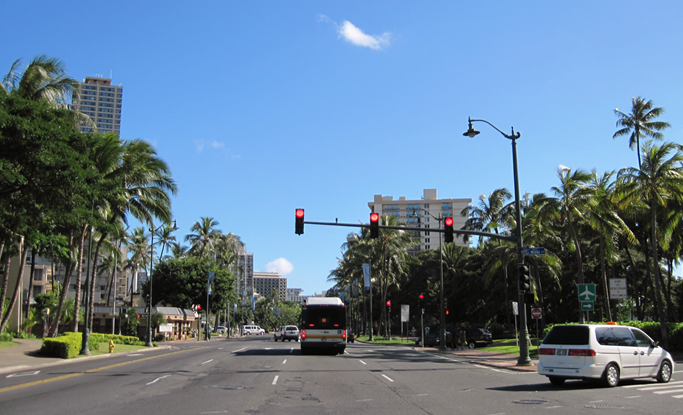
The V2X traffic control system deployment along Nimitz Highway and Ala Moana Boulevard in Honolulu helped improve safety, mobility, and signal efficiency. Because this project uses cutting‑edge connected vehicle (V2X) technologies, the system enhances how signals manage traffic and support multiple modes of travel. This effort was a collaboration between the Hawaii Department of Transportation (HDOT), the University of Hawaii College of Engineering, and Econolite.
Project Background and Objectives
This V2X traffic control system was implemented on a 5.25‑mile arterial with 36 signalized intersections. The goal was to improve travel time, reduce vehicle delay, and increase safety for motorists, transit, cyclists, and pedestrians. Because traditional signal systems cannot communicate directly with vehicles or road users in real time, the connected system uses V2X and advanced control features to provide dynamic signal adjustments.
The pilot included several advanced components, such as integration with the Centracs® ATMS for centralized signal management and the use of the Centracs® Signal Performance Measures and Edaptive analytics for real‑time performance reporting.
Innovative Technologies Deployed
Multiple cutting‑edge technologies were part of this project. These included V2X communications through roadside units (RSUs) and communication links that support both cellular V2X (C‑V2X) and DSRC V2X. These technologies enable two‑way communication between infrastructure and vehicles, pedestrians, and cyclists — improving situational awareness.
Connected Vehicle Features – Including red light violation warnings, pedestrian alerts, queue warnings, and transit signal priority.
Advanced Controllers & Detection – Econolite’s Cobalt® controllers with EOS firmware and Autoscope® Vision VDS provided high‑resolution traffic data.
Adaptive Control Optimization – Data feeds into analytics dashboards, which refine signal timing plans dynamically.
Traveler Information – Via a connected app that pushes safety alerts and real‑time travel info to road users.
Key Results and Operational Impact
As a result of this V2X traffic control system deployment, significant improvements were observed along the corridors:
- Increased arrivals on green by 8.6%
- Decreased vehicle delay by 56.3% across key segments
- Travel time reduced by 50% in measured runs
- Carbon emissions and fuel consumption both decreased by over 16% due to smoother flow
Overall, this project demonstrated how connected infrastructure and ATMS can work together to improve signal coordination, enhance safety, and support future connected and autonomous vehicle deployments. Integration with tools like Centracs, adaptive signal control, and data analytics helped make these results possible.